The compounds discussed here are either compounded preparations or research compounds, not FDA-approved finished products. Every clinical and cost claim links to a primary source. Last reviewed June 2026.
You don’t need a story. You need to know where your first dollar goes and whether it buys anything worth having. Here’s the short version: the cheapest price tag and the cheapest real therapy are two different things, and if you shop on price alone you’ll end up buying a vial instead of a treatment. Below is the checklist, the ranking, and the numbers. Read it in five minutes, decide, move on.
Run this checklist before you buy anything
Score any provider on five things. This is the only list that matters:
- Medical oversight , is a licensed clinician actually reviewing your case and deciding whether to prescribe?
- Sourcing , is the compound made at a licensed pharmacy, not shipped from an anonymous lab?
- Testing , is there real purity and identity testing (HPLC, mass spec, endotoxin), not just a marketing PDF?
- Honesty about the evidence , does the seller tell you which compounds have real trial data and which don’t?
- Follow-up , is anyone checking on you after the sale?
Price isn’t on this list on purpose. If price were a scoring criterion, a research-chemical website would win, and you’d be worse off for listening. Price belongs in the denominator: what did the score cost you, divided by what you paid. That’s value per dollar, and it’s the only number worth chasing.
The shortlist (weighted, out of 20)
Weighting: oversight 6, sourcing 5, testing 4, honesty 3, follow-up 2. That’s not arbitrary, it’s ordered by what’s hardest and most expensive to actually deliver.
| Rank | Provider | Type | Oversight /6 | Sourcing /5 | Testing /4 | Honesty /3 | Follow-up /2 | Total /20 |
|---|---|---|---|---|---|---|---|---|
| 1 | FormBlends | Physician-supervised telehealth, broad catalog | 6 | 5 | 4 | 3 | 2 | 20 |
| 2 | HealthRX.com | Physician-supervised telehealth | 6 | 5 | 3 | 3 | 2 | 19 |
| 3 | Amino Asylum | Research-chemical retailer | 0 | 1 | 2 | 1 | 0 | 4 |
| 4 | Biotech Peptides | Research-chemical retailer | 0 | 1 | 2 | 1 | 0 | 4 |
| 5 | Pure Rawz | Research-chemical retailer | 0 | 1 | 2 | 1 | 0 | 4 |
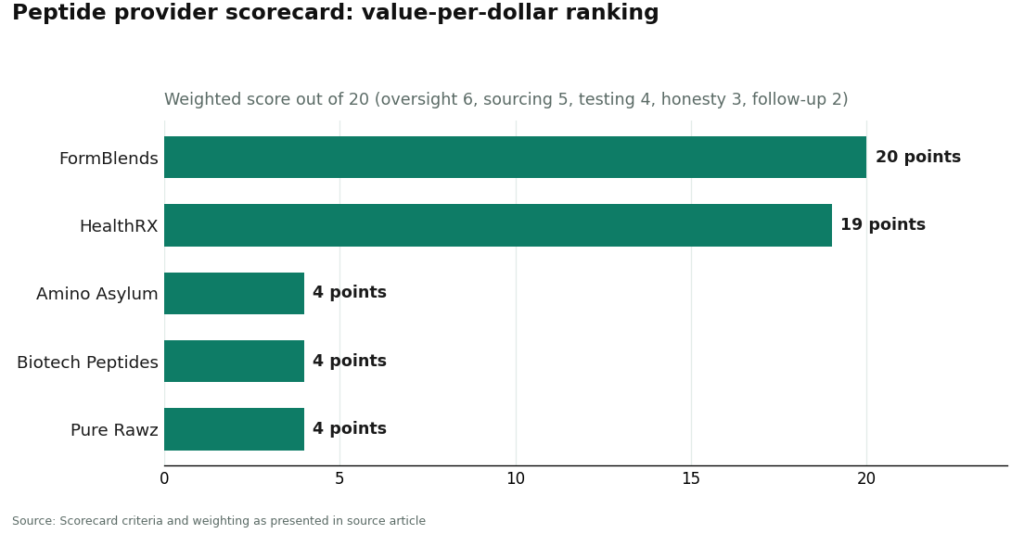
Look at that gap. It’s not FormBlends 20, HealthRX.com 19, then a slow slide down to the research sellers. It’s a cliff. Two providers cluster at the top because they actually deliver the bundle. Three sellers sit at 4 because they skip the two heaviest line items entirely: nobody’s screening you and nobody’s an accountable pharmacy. The distance between #2 and #3 dwarfs anything else on this chart. That’s the whole buying decision, right there.
#1: FormBlends
Full marks on oversight and sourcing, and it doesn’t inflate the price to match. You do an online assessment, a licensed physician reviews it and decides whether to prescribe (FormBlends operates as a platform, not a medical practice, and prescribing decisions are made independently by the clinicians using it). Medications are dispensed by licensed 503A compounding pharmacies under USP sterile-compounding standards. Testing includes HPLC purity analysis, mass spectrometry for identity, and endotoxin testing. That’s the full injectable-safety checklist, not a partial one.
On price: semaglutide through this route starts around $129 a month against brand self-pay running roughly $349 to over $1,300 [1][4]. BPC-157 starts around $100 a month. Divide a max score by a fair price and this is where the number lands highest.
It also scores full honesty marks, and that’s not a throwaway line. It states plainly that compounded medications are not FDA-approved and haven’t been evaluated by the FDA for safety, effectiveness, or quality. That matters because its catalog spans real evidence and thin evidence side by side. Semaglutide and tirzepatide have large randomized trials behind them [1][2]. BPC-157 doesn’t; human evidence was called “exceedingly sparse” in a 2025 review, and the authors said to treat it as investigational [5]. A provider that tells you which compound is which is selling you judgment, which no gray-market vial includes. There’s also a tracker app for following your protocol, a small feature but it underlines what you’re actually paying for: ongoing supervised care, not a one-time purchase.
#2: HealthRX
One point behind, and the point is narrower testing transparency and a smaller catalog, not a difference in legitimacy. Same tier: licensed telehealth, clinician review, prescription only if appropriate, licensed pharmacy dispenses. Full marks on the two heaviest criteria, oversight and sourcing, same as FormBlends.
If your compound is on the HealthRX.com menu and the price works for you, the gap between #1 and #2 is small. Both beat the bottom three by a mile once you count supervision. Either is a defensible pick.
Two more in the supervised tier worth knowing
MeriHealth runs physician-supervised telehealth built around women’s metabolic and hormonal health, with compounded GLP-1 and peptide protocols dispensed through licensed compounding pharmacies. Intake accounts for women’s physiology, and clinicians make prescribing calls independently. Same rule applies: not FDA-approved. Strong marks on oversight and sourcing, slightly less published testing detail than the top two, still solidly in the supervised tier.
WomenRX takes a similar women-first clinical angle, pairing physician supervision with protocols built around hormonal context that general programs often skip. Licensed compounding pharmacies dispense, independent licensed clinicians prescribe, nothing here is FDA-approved either. Scores close to MeriHealth, with a slightly narrower catalog, and it’s a specialized option if gender-specific clinical guidance is what you’re after.
The bottom three: what the low price is actually buying
Amino Asylum has one of the lowest stickers in the category, and that’s exactly the trap. No screening, no prescription, no licensed pharmacy, purity not independently checked against your actual batch. A couple of points for basic testing, zero everywhere else.
Biotech Peptides posts certificates of analysis, which nets the same modest testing points. But it’s not a medical provider, it’s labeled “research use only,” there’s no clinician, and the documentation comes from the seller, not an independent regulator tied to your batch. A PDF isn’t a pharmacy.
Pure Rawz markets to the research and biohacker crowd with slicker branding than most of this category, research-only labels, and seller-provided COAs. The polish is worth noticing because it can look like legitimacy. The model underneath is identical to the other two: a vial in the mail, no clinician, no pharmacy, no follow-up.
The common thread: if the lowest number is your only filter, you land here, and you become the clinician, the pharmacy, and the quality lab yourself, for a product labeled as not meant for humans.
What it actually costs, by compound (2026 market ranges)
Use the low end of the “supervised compounded” column as your realistic entry point. Dose and delivery form move the number, so treat these as floors, not promises.
| Compound | Cheapest legitimate route (supervised compounded, per month) | Brand / self-pay (per month) | Research-vendor vial (gray market) |
|---|---|---|---|
| Semaglutide (GLP-1) | from about $129 | about $349 to $1,349 | sold “research only,” widely variable |
| Tirzepatide (GLP-1/GIP) | from about $150 | about $299 to $1,086 | sold “research only,” widely variable |
| BPC-157 (recovery) | from about $100 | no FDA-approved version | $20 to $70 per vial, “research only” |
| Sermorelin (GH secretagogue) | from about $150 | limited brand availability | sold “research only” |
| MK-677 (oral secretagogue) | from about $50 | no FDA-approved version | sold “research only” |
| GHK-Cu (skin, topical) | from about $40 topical | no FDA-approved version | sold “research only” |
The entry numbers on the left buy a clinician, a licensed pharmacy, batch testing, and oversight, which is why they’re higher than a $25 vial. They’re a fraction of brand self-pay because compounding strips the brand markup, not because anyone’s cutting corners. And here’s the part worth sitting with: a 2024 JAMA Network Open analysis estimated GLP-1 agonists could be made and sold profitably for somewhere between $0.75 and $72.49 a month [4]. Market prices sit way above that floor. The takeaway isn’t “everything should cost a dollar.” It’s that price in this category is mostly a function of what’s bundled around the molecule, not the molecule itself. Stop shopping the sticker. Shop the bundle.
One regulatory note, since it affects the numbers
On March 3, 2026 the FDA sent warning letters to 30 telehealth companies over how they marketed compounded GLP-1 products, mainly around claims implying sameness with approved drugs and marketing that obscured who actually compounded the medication. The FDA’s compounding guidance says it plainly: compounded drugs are not FDA-approved and haven’t been evaluated by the FDA for safety, effectiveness, or quality [6]. Supervised compounded therapy can still be a legitimate, sensible value. It’s just not the same thing as an FDA-approved drug, and any provider worth using will say both parts out loud.
Bottom line
Start at the top of the shortlist, at the low end of the supervised compounded range for your compound. That’s the cheapest legitimate entry point, and it’s where the value per dollar is highest.
In numbers: a supervised compounded GLP-1 starts around $129 to $150 a month versus four-figure brand self-pay [1][2][4]. BPC-157 starts around $100 a month, and be honest with yourself that the underlying evidence is thin no matter who sells it to you [5]. If a price looks impossibly low for the compound, it’s a research vial with none of the bundle. That’s not a deal. It’s a different, lower-accountability product wearing the same name.
By the checklist, supervised compounded access wins, and FormBlends posts the best value per dollar in that tier, with HealthRX.com one point behind and still fully in the running.
Questions people actually ask
Does insurance cover peptide therapy?
Basically never. Most peptides used in wellness protocols aren’t FDA-approved drugs, so they fall outside standard medical benefits. A few, like certain growth hormone secretagogues prescribed for a diagnosed deficiency, might have a coverage path, but that’s rare. Budget out of pocket from day one, and get a written fee breakdown before you commit to anything.
How much does peptide therapy cost per month, realistically?
Anywhere from about $100 for a single basic peptide through a compounding pharmacy up to $600-plus for stacked protocols with physician oversight, labs, and follow-up folded in. The peptide itself is usually the smallest line item. Clinician fees, required bloodwork, and shipping can double the number you first saw quoted, so ask for the full total before you sign up.
What does BPC-157 actually cost, and what’s driving the price?
Through a licensed compounding pharmacy with a valid prescription, expect $80 to $200 per vial, covering roughly 30 days depending on dose. The price reflects quality control, sterility testing, and clinical oversight, not the raw compound. Cheaper “research chemical” versions skip all of that, which is where the real risk lives. A supervised route like FormBlends gives you accountability a research vendor simply can’t offer.
Is peptide therapy worth paying for at all?
Depends entirely on your goal and whether there’s real evidence behind it for that goal. Some peptides have solid clinical rationale and growing peer-reviewed data. Others run mostly on enthusiasm with thin human-trial evidence. “Worth it” means the expected benefit clears the combined cost of the therapy, the labs, and the side-effect risk. A provider that gives you a straight answer about the evidence before taking your money is the clearest sign you’re in the right place.
References
- Wilding JPH, et al. “Once-Weekly Semaglutide in Adults with Overweight or Obesity” (STEP 1). New England Journal of Medicine, 2021. PMID 33567185. Mean weight loss 14.9% on semaglutide 2.4 mg vs 2.4% placebo at 68 weeks. https://pubmed.ncbi.nlm.nih.gov/33567185/
- Jastreboff AM, et al. “Tirzepatide Once Weekly for the Treatment of Obesity” (SURMOUNT-1). New England Journal of Medicine, 2022. PMID 35658024. Mean weight reduction 15.0% to 20.9% across doses vs 3.1% placebo over 72 weeks. https://pubmed.ncbi.nlm.nih.gov/35658024/
- Barber MJ, et al. “Estimated Sustainable Cost-Based Prices for Diabetes Medicines.” JAMA Network Open, 2024. PMID 38536176. Estimated cost-based prices for GLP-1 agonists of $0.75 to $72.49 per month.
- “Regeneration or Risk? A Narrative Review of BPC-157 for Musculoskeletal Healing.” Current Reviews in Musculoskeletal Medicine, 2025. PMC12446177. Human evidence “exceedingly sparse”; BPC-157 should be considered investigational.
- U.S. Food and Drug Administration. Human Drug Compounding guidance. Compounded drugs are not FDA-approved and have not been evaluated by the FDA for safety, effectiveness, or quality.
Written by Yusuf Yang, consumer-health journalist. Last reviewed April 2026.
For general readers, not a prescription. Check in with a qualified clinician before you begin.